The Guinness Fleets of Boats, ships and yachts
Edward J Bourke The Guinness brewing concern had substantial maritime resources to support distribution of the famous beer. In addition the family spent a lot of their leisure on a range of fabulous pleasure craft. Initially the reach of the brewing concern expanded from 1790 thanks to the commencement of the Irish canal system. Barge transport enabled distribution of their beer from Dublin and import of malt from all parts of the country. This led to grain depots; maltings and beer distribution depots being situated on can al banks and ultimately brought about the decline of the tiny country breweries that served the smaller towns. In order to serve the UK market beer was shipped from Dublin port. Initially quantities were small, but from 1877 when the brewery at St James’s gate expanded considerably a jetty was built at Victoria quay upstream on the Liffey and barges or more correctly lighters carried the beer from the brewery to ships in the port. From 1913 Guinness became ship-owners and used their own cross channel fleet to serve Liverpool, Manchester, London and Bristol.
Guinness barges

- Athy maltings at canalside
It was the good ship Vartry That sailed the sweet Liffee, And the skipper had taken the casks aboard, A goodly companee. Blue were the labels, and azure blue, Proclaiming double x, But neither the skipper nor the crew Had dreamt of storms or wrecks. Now as she steamed by the Ha'penny Bridge, The engine raised a row, While a cloud no bigger than a midge Loomed up on the starboard bow. And as they steered by Aston's quay, The lookout man grew pale, "I feared we'd not escape,” says he, "McBirney's summer sale". And ere they reached the Customs House, Down in a wild vortex, The Vartry plunged, the cause was plain, She'd too much Double X. All you who drink of James Gate, (No matter what your sex), Take warning by the Vartry's fate, Thro' too much Double X.
| Name | Built | Notes | Disposed |
| Lagan | Harland & Wolfe 1877 | Sunk 1970s at Sandy Bay, Lurgan as foundations at Scotts | |
| Shannon | Allsop, Preston 1883 | Double ended and could proceed forwards or backwards | Sold and sank off Balbriggan |
| Liffey | Ross & Walpole, Dublin 1888 | Commandeered in WW1 for service in France! | Wrecked at Skane flat Lough Neagh still visible |
| Lee | Ross & Walpole, Dublin 1889 | ||
| Boyne | Ross & Walpole, Dublin 1891 | Commandeered in WW1 for service in France | Embedded in Hutchesons sand quay |
| Slaney | Ross & Walpole, Dublin 1892 | Sunk at Tarmac as foundations for quay | |
| Siur | Ross & Walpole, Dublin 1892 | Long of Cork worked on river Slaney | |
| Foyle | Ross & Walpole, Dublin 1897 | Sank on rocks near Lurgan 1950s | |
| Moy | Ross & Walpole, Dublin 1897 | J Tinsley Belfast | |
| Vartry | Ross & Walpole 65/67 North Wall 1902 | James Transport London, then Belfast | |
| Dodder | Ross & Walpole, Dublin 1911 | Broken at Lees Carlingford 1946 | |
| Tolka | Ross & Walpole, Dublin 1913 | Hamilton Gabbie Comber co Down | |
| Docena | Built in Norwich Bought UK 1920 | Sank at Custom House but raised | Scrapped 1950 |
| Farmleigh | Vickers (Ireland) Alexandra basin 1927 | Sold to RN 1938 | Used at Scapa Flow |
| Knockmaroon | Vickers (Ireland) Alexandra basin 1929 | Sold 1938 | John Hunt, Leeds |
| Chapelizod | Vickers (Ireland) Alexandra basin 1929 | Sold 1938 | Blown up on Lough Neagh 1970 |
| Fairyhouse | Vickers (Ireland) Alexandra basin 1929 | Sold To RN 1938 | Worked on Humber and was at Dunkirk evacuation |
| Castleknock | Vickers (Ireland) Alexandra basin 1929 | Sold 1961 | Blown up on Lough Neagh 1970 |
| Clonsilla | Vickers (Ireland) Alexandra basin 1930 | Sold 1961 | Sank in Lough Neagh during a storm in 60 feet depth of water |
| Killiney | Vickers (Ireland) Alexandra basin 1930 | Sold 1961 | Sunk 1970s at Ballyginiff point as foundations |
| Sandyford | Vickers (Ireland) Alexandra basin 1931 | Sold 1961 | |
| Howth | Vickers (Ireland) Alexandra basin 1931 | Sold 1961 | |
| Seapoint | Vickers (Ireland) Alexandra basin 1931 | Sold 1961 |
Guinness company Ships

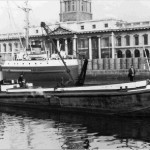
- Grainne at Runcorn
 The task was more advanced another day and the tanks were being steamed. Whatever following wind conditions prevailed the ship was shrouded in clouds of steam as it made its way past the South Stack and out to sea toward Dublin. An aeroplane passing overhead observed this strange sight and promptly reported that the Patricia was on fire and a lifeboat was launched to assist before all was declared safe. The Miranda had a collision with the East Link toll bridge on the Liffey while outward bound one day. It was thought that her bow thruster had caused her to deviate from her course. More seriously on 10 November 1961 the Lady Gwendolen ran down the Freshfield lying at anchor during fog in the Mersey. The incident is widely quoted in Maritime case law. Ironically the Lady Gwendolen (then called Paros) was herself rammed and sunk at anchor on 10 November 1979 at Ravenna. The Lady Patricia was in reserve for the Miranda Guinness for a few years and only operated when the Miranda was on annual overhaul. This gave an opportunity to be used for film work. When the Patricia played the part of the emigrant ship in the film Far and Away the first officer was admonished for daring to appear on the bridge during the important work of filming. He had merely thought it prudent to steer the ship. The Patricia also played the mail boat in Hear my Song (1991).
| Name | Tons | Built | Bought from | Disposed |
| W.M Barkley | 569 | Ailsa, Troon 1898 | 1913,Kellys, Belfast, | Torpedoed and sank 1917 |
| Carrowdore | 598 | Bowling 1914 | Kellys, 1914 | Sold to Davidsons Belfast 1952, broken 1959 |
| Clarecastle | 664 | Bowling 1914 | Kellys, 1915 | Sold to Davidsons Belfast 1953, broken 1959 |
| Clareisland | 633 | Bowling 1915 | Kellys, 1915 | Sold, 1931 to Antrim Iron Ore Co and sank near Isle of Man 1939 |
| Guinness | 1151 | Ailsa Troon, 1931 | Served the Dublin to London trade to 1938, disposed 1963 | |
| Lady Grania | 1252 | Ailsa Troon, 1952 | Sold 1976 renamed Lady Scotia Stranded On Pacific coast of Mexico 1981 | |
| Lady Gwendolen | 1166 | Ardross Dockyard 1953 | Sold 1977 to Cypriot shipping renamed Paros and sank off Nova Scotia 1979 | |
| Lady Patricia | 1187 | Charles Hill Bristol 1962 | Broken April 1993 | |
| Miranda Guinness | 1540 | Charles Hill, 1976 Bristol | Broken April 1993 |

- Fantome
Some Yachts owned by the Guinness family
This is an incomplete list of the pleasure craft owned by the Guinness family. They ranged from racing yachts to super luxury steamers and sailing craft and even included sponsoring Jacques Cousteau’s famous Calypso.| Vessel | Owner | Size | comment |
| Lady Olive | Lord Ardilaun | Struck Rock in Corrib 7-2-1872, relieved Captain Boycott | |
| Medusa II | Guinness | 627 ton | 1906-1915, sunk as HMY Mollusc off Blyth |
| Sea Huntress | Loel Guinness | Married Princess Gloria aboard, off Antibes | |
| Cetonia | Edward Cecil | Schooner | 1880 |
| Ceto | Edward Guinness | 106 ton | Entertained Prince Edward at Cowes 1886 accompanied by Mrs Keppel |
| Leander | Rupert Guinness | 90 foot yawl | Won King’s Cup at Cowes |
| Atlantis | Loel Guinness | 216 ton | |
| Calypso | Loel Guinness | 330 ton | In the course of preservation at Brest |
| Fantome | Arthur Ernest Guinness | 139 ton | 1906-1938 |
| Fantome | Arthur Ernest Guinness | Ex Belem | 1921-1951 |
| Fantome | Arthur Ernest Guinness | Ex Flying Cloud, four masted | 1938-1951 |
| Rossaura | Lord Moyne | 1400 ton ex Dieppe | 1933 – 1940, Sank off Torbruk |
| Roussalka | Lord Moyne | 1400 ton ex Brighton | 1931 -1933, Sank off Killary |
| Amo | Arthur Ernest Guinness | Ex ML 482 | 1928-1949, scrapped in Dublin |
| Rob Roy McGregor | John Guinness (banking family) |